
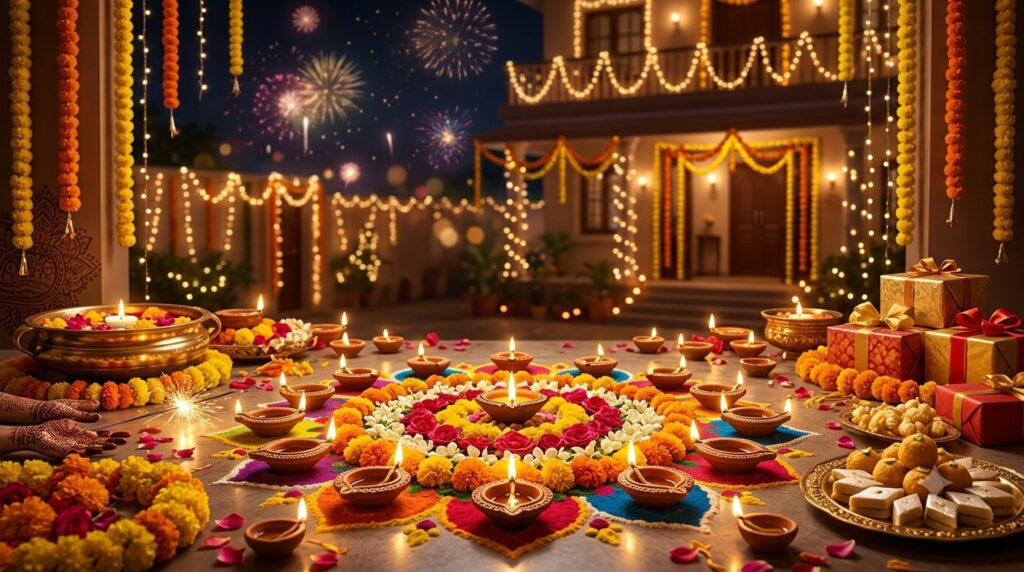
Diwali, also called Deepavali, is one of the most widely observed festivals across Hindu, Jain, and Sikh communities, and is popularly known as the “Festival of Lights.” Homes, streets, and temples are lit with oil lamps (diyas) and decorated with rangoli patterns, marking the symbolic triumph of light over darkness and knowledge over ignorance.
When is Diwali celebrated?
Diwali falls on Amavasya (the new moon Tithi) of Krishna Paksha in the Hindu lunar month of Kartik, which typically places it in October or November on the Gregorian calendar. The exact date shifts each year because the Hindu calendar is lunisolar.
This Year's Panchang Details
Sunday, November 8, 2026
- Tithi
- Chaturdashi
- Paksha
- Krishna Paksh
- Nakshatra
- Swati
- Yoga
- Ayushman
- Karana
- Shakuni
- Hindu Month (Amavasyant)
- Ashwin
- Hindu Month (Poornimant)
- Kartika
- Moon Rashi
- Libra(Tula)
- Sun Rashi
- Libra(Tula)
Why is Diwali celebrated?
At its core, Diwali marks the victory of light over darkness, knowledge over ignorance, and good over evil. The specific event being celebrated varies by region and tradition, but this underlying theme is shared across nearly all of them.
Religious and spiritual significance
For most Hindus, Diwali is associated with the return of Lord Rama to Ayodhya after 14 years of exile and his victory over Ravana, as told in the Ramayana — the diyas lit that night are said to represent the city welcoming him home. In many parts of North and West India, the festival is also closely tied to the worship of Goddess Lakshmi, the goddess of wealth and prosperity, who is believed to visit homes that are clean, lit, and welcoming on this night. In parts of East India, particularly West Bengal, the same night is observed as Kali Puja, honoring the goddess Kali instead. For Jains, Diwali marks the anniversary of Lord Mahavira’s attainment of moksha (spiritual liberation). For Sikhs, the same period overlaps with Bandi Chhor Divas, commemorating Guru Hargobind Ji’s release from imprisonment.
These traditions are not mutually exclusive — many families and communities observe more than one of these meanings simultaneously.
History and background
Diwali’s roots are old enough that its exact origin isn’t attributed to a single historical event; references to a festival of lights around this time of year appear across multiple ancient and classical-era Sanskrit texts. Over centuries, it absorbed and blended regional harvest festivals, royal traditions, and the distinct religious narratives described above, which is part of why its meaning today varies so much by community and geography.
Mythological story
The following reflects traditional belief and scripture, not verified historical fact.
The most widely told account, drawn from the Ramayana, describes how Lord Rama, his wife Sita, and his brother Lakshmana returned to their kingdom of Ayodhya after Rama defeated the demon king Ravana and completed 14 years of exile. The people of Ayodhya are said to have lit rows of oil lamps throughout the city to welcome them home and light their path — the origin, in this telling, of Diwali’s defining ritual.
A second widely told story, more prominent in South and West India, describes Lord Krishna’s defeat of the demon Narakasura on the day before the main Diwali night, freeing thousands of captives and ridding the world of his tyranny — this is why that preceding day is separately observed as Naraka Chaturdashi.
How Diwali is traditionally celebrated
Diwali is usually observed over five days, though the customs and even which days are included vary by region:
- Dhanteras — the first day, associated with wealth and new purchases, especially gold, silver, or utensils.
- Naraka Chaturdashi (Choti Diwali) — the second day, marking Krishna’s victory over Narakasura in traditions that observe it.
- Diwali / Lakshmi Puja — the main day, with home lighting, fireworks, and worship of Lakshmi and Ganesha in most traditions.
- Govardhan Puja — observed by many North Indian communities the day after, honoring Krishna’s lifting of Govardhan Hill.
- Bhai Dooj — the closing day, celebrating the bond between brothers and sisters.
Important rituals and customs
- Cleaning and decorating the home, often including rangoli designs at the entrance.
- Lighting rows of oil lamps (diyas) and, in many homes today, string lights.
- Lakshmi Puja on the main evening, with offerings to Goddess Lakshmi and Lord Ganesha for prosperity and good fortune.
- Exchanging gifts and sweets with family, friends, and neighbors.
- Wearing new or festive clothing.
- Fireworks, though their use has become a subject of environmental debate in many Indian cities in recent years.
Regional variations
Diwali’s observance differs meaningfully by region: North India centers it on the Rama-Ayodhya narrative; South India often emphasizes the Krishna-Narakasura story and celebrates it a day earlier relative to North Indian observance; West Bengal and much of East India observe Kali Puja on the same night rather than Lakshmi Puja; and Gujarati communities traditionally treat the day after Diwali as the start of a new financial year. This list reflects commonly cited regional patterns rather than an exhaustive account — practice varies further by community, family, and local tradition.
Related festivals
Diwali is closely linked to Dhanteras, Naraka Chaturdashi, Govardhan Puja, and Bhai Dooj, which together make up the wider Diwali festival period, as well as to Kali Puja for communities that observe it on the same night.
Related Panchang concepts
- Tithi & Paksha — understand the lunar day Diwali is calculated from (Amavasya, Krishna Paksha).
- Hindu Calendar Months — learn about Kartik and the rest of the Hindu lunisolar month cycle.
- Full Year Panchang — look up this year’s date for Diwali and every other festival at a glance.
Frequently Asked Questions
Is Diwali celebrated on the same date every year?
No. Diwali follows the Hindu lunisolar calendar, so its Gregorian date shifts from year to year, generally falling somewhere between mid-October and mid-November.
Is Diwali only a Hindu festival?
No. While it’s most widely associated with Hindu tradition, Diwali is also a significant observance for Jains (marking Mahavira’s liberation) and overlaps with Bandi Chhor Divas for Sikhs.
Why are lamps lit on Diwali?
Lighting diyas is traditionally understood as symbolizing the victory of light over darkness and knowledge over ignorance, and in the Rama-Ayodhya telling, as literally lighting the way for Rama’s return home.
Dates by year: 2025 · 2026 · 2027 · 2028 · 2029 · 2030 · 2031 — all Hindu festival dates