
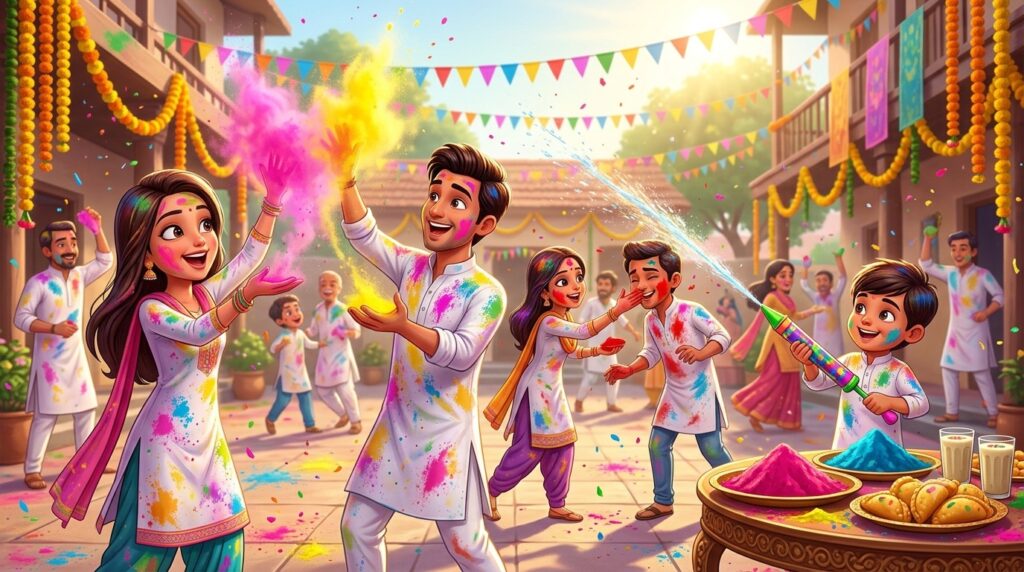
Holi, often called the “Festival of Colors,” is one of the most exuberant festivals in the Hindu calendar — a day of throwing colored powder and water, singing, dancing, and setting aside old grudges. It marks the arrival of spring and, like Diwali, carries a strong theme of good triumphing over evil.
When is Holi celebrated?
Holi falls on Purnima (the full moon Tithi) of Shukla Paksha in the Hindu lunar month of Phalgun, usually placing it in February or March on the Gregorian calendar. The bonfire ritual, Holika Dahan, takes place on the evening of Purnima itself, with the main color-throwing celebration (sometimes called Dhulandi or Rangwali Holi) the following morning.
This Year's Panchang Details
Wednesday, March 4, 2026
- Tithi
- Prathama
- Paksha
- Krishna Paksh
- Nakshatra
- PurvaPhalguni
- Yoga
- Dhriti
- Karana
- Kaulav
- Hindu Month (Amavasyant)
- Phalguna
- Hindu Month (Poornimant)
- Chaitra
- Moon Rashi
- Leo(Simha)
- Sun Rashi
- Aquarius(Kumbh)
Why is Holi celebrated?
Holi marks two connected ideas: the victory of devotion and good over arrogance and evil, told through the story of Holika and Prahlad, and a joyful welcome to spring and the new harvest season. The color-throwing itself is widely understood as a celebration of life, renewal, and equality — for one day, differences of status are meant to dissolve in shared color and laughter.
Religious and spiritual significance
Holi is associated with Lord Vishnu’s devotee Prahlad, whose unwavering faith is said to have protected him from his father’s attempts to kill him, and with Lord Krishna, whose playful color-throwing with Radha and the gopis in Vrindavan and Mathura is the origin most closely tied to Holi’s color tradition in North India. In parts of South India, the day is instead linked to Kamadeva, the god of love, and a story of his sacrifice.
History and background
References to a spring festival involving color and community celebration appear in Indian literature and temple art going back many centuries, though, as with most festivals this old, no single founding event can be pinned down with certainty. Over time Holi absorbed regional harvest celebrations alongside its devotional and mythological associations, which is part of why its exact customs vary so much by region today.
Mythological story
The following reflects traditional belief and scripture, not verified historical fact.
The most widely told account describes the demon king Hiranyakashipu, who demanded to be worshipped as a god, and his son Prahlad, who refused and remained devoted to Lord Vishnu instead. Hiranyakashipu’s sister, Holika, was said to be immune to fire; she sat in a bonfire with Prahlad on her lap, intending to burn him while she remained unharmed. Instead, Prahlad’s devotion protected him, and Holika was consumed by the flames — the origin, in this telling, of the Holika Dahan bonfire lit the night before Holi.
A second widely told story, more central to the color tradition itself, describes a young Krishna, self-conscious about his dark skin, playfully applying color to Radha and the gopis of Vrindavan at his mother Yashoda’s suggestion — a tradition that Braj-region Holi celebrations still directly reenact today.
How Holi is traditionally celebrated
- Holika Dahan — on the evening before the main day, communities light bonfires symbolizing the burning of Holika and the victory of good over evil.
- Rangwali Holi / Dhulandi — the main day, when people go out into streets, courtyards, and open spaces to throw colored powder (gulal) and water at each other, regardless of age or status.
- Music, dancing, and traditional sweets and drinks, including gujiya and, in some regions, bhang-infused thandai.
- Visiting family and friends, and using the day to set aside old disputes.
Important rituals and customs
- Gathering wood and combustible material for the community Holika Dahan bonfire in the days before.
- Performing a small puja at the bonfire site before lighting it.
- Applying colored powder to elders first, traditionally, as a mark of respect, before the free-for-all color play begins.
- Sharing sweets and festive food with neighbors and family.
Regional variations
Holi’s observance varies significantly by region: Lathmar Holi in Barsana (Uttar Pradesh) features women playfully beating men with sticks, reenacting a local Krishna-Radha legend; Basant Utsav in West Bengal, associated with Rabindranath Tagore’s Shantiniketan, treats Holi as a spring cultural festival with music and dance rather than water fights; Yaosang in Manipur extends the celebration over several days with its own distinct customs; and Sikh communities in Anandpur Sahib observe the overlapping festival of Hola Mohalla with martial displays around the same time. This list reflects commonly cited regional patterns rather than an exhaustive account.
Related festivals
Holi is directly preceded by Holika Dahan, its opening bonfire ritual observed the evening before. It falls in the same general season as Hola Mohalla, observed by Sikh communities.
Related Panchang concepts
- Tithi & Paksha — understand the lunar day Holi is calculated from (Purnima, Shukla Paksha).
- Hindu Calendar Months — learn about Phalgun and the rest of the Hindu lunisolar month cycle.
- Full Year Panchang — look up this year’s date for Holi and every other festival at a glance.
Frequently Asked Questions
Why are bonfires lit the night before Holi?
The bonfire, Holika Dahan, traditionally represents the burning of the demoness Holika and the victory of Prahlad’s devotion over her attempt to harm him.
Is Holi celebrated the same way across India?
No. While color-throwing is common nationwide, specific customs vary widely by region — from Barsana’s Lathmar Holi to Bengal’s more cultural Basant Utsav observance.
Is Holi only about throwing colors?
No. The color play is the best-known part, but Holi also includes the Holika Dahan bonfire the evening before, communal food and music, and a broader theme of forgiveness and renewal.
Dates by year: 2025 · 2026 · 2027 · 2028 · 2029 · 2030 · 2031 — all Hindu festival dates