
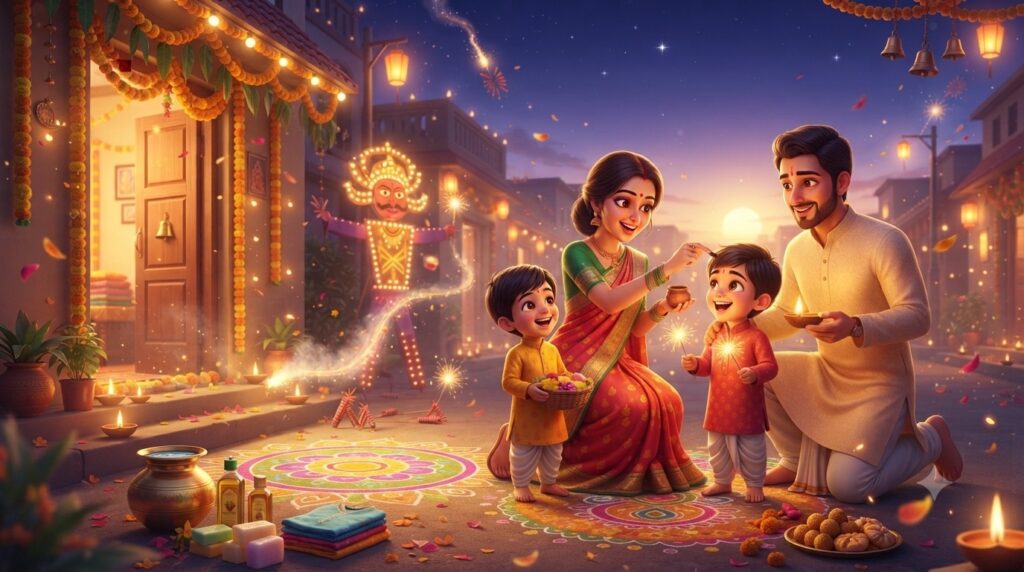
Naraka Chaturdashi, also called Choti Diwali (“Little Diwali”), is the second day of the five-day Diwali festival period, marking Lord Krishna’s defeat of the demon Narakasura. In much of South India, it’s observed as the primary day of Deepavali celebration itself.
When is Naraka Chaturdashi celebrated?
Naraka Chaturdashi falls on Chaturdashi (the fourteenth Tithi) of Krishna Paksha in the Hindu lunar month of Kartik, the day before the main Diwali night (Amavasya), typically in October or November on the Gregorian calendar.
This Year's Panchang Details
Sunday, November 8, 2026
- Tithi
- Chaturdashi
- Paksha
- Krishna Paksh
- Nakshatra
- Swati
- Yoga
- Ayushman
- Karana
- Shakuni
- Hindu Month (Amavasyant)
- Ashwin
- Hindu Month (Poornimant)
- Kartika
- Moon Rashi
- Libra(Tula)
- Sun Rashi
- Libra(Tula)
Why is Naraka Chaturdashi celebrated?
The day celebrates Krishna’s defeat of the demon Narakasura, who had imprisoned thousands of people and caused widespread suffering. His defeat is treated as removing a source of darkness and tyranny just before the main night of Diwali’s lights.
Religious and spiritual significance
The traditional pre-dawn oil bath (abhyanga snan) taken on this day is believed to cleanse both body and spirit, symbolically washing away sin and darkness ahead of Diwali’s main night. In several South Indian traditions, this ritual bath and the day’s puja are treated as the principal Deepavali observance.
History and background
Naraka Chaturdashi’s core story appears in the Bhagavata Purana and other Puranic sources describing Krishna’s various demon-slaying episodes. The distinct North-South emphasis — a secondary “Choti Diwali” day in the north versus the primary Deepavali day in parts of the south — reflects the same broad regional diversity found across the wider Diwali festival period.
Mythological story
The following reflects traditional belief and scripture, not verified historical fact.
According to the Bhagavata Purana, the demon Narakasura, ruler of Pragjyotishapura, had grown tyrannical, imprisoning 16,000 women and stealing the earring of the goddess Aditi. Lord Krishna, accompanied by his wife Satyabhama in most tellings, fought and killed Narakasura, freeing the captives and returning the stolen earring. Before dying, Narakasura is said to have asked that his death be remembered as a day of joy rather than mourning — which many traditions cite as the reason the day is celebrated rather than solemnly observed.
How Naraka Chaturdashi is traditionally celebrated
- A ritual oil bath before sunrise, often using scented oils and ubtan (a traditional herbal paste).
- Lighting lamps and small fireworks in the evening, a smaller-scale preview of the main Diwali night.
- In many South Indian households, this day’s morning bath and puja constitute the primary Deepavali celebration, followed by visiting family and sharing sweets.
Important rituals and customs
- Waking well before sunrise for the ritual bath, considered inauspicious to skip in many families.
- Applying ubtan or scented oil before bathing.
- Wearing new clothes afterward and visiting a temple.
- Preparing and sharing festive sweets with family and neighbors.
Regional variations
In Tamil Nadu, Andhra Pradesh, Telangana, and Karnataka, this day — called Deepavali locally — is the primary festival day, celebrated with the oil bath, new clothes, and fireworks, rather than the following Amavasya night. In much of North India, it functions as a smaller “Choti Diwali” lead-in to the main night.
Related festivals
Naraka Chaturdashi is the second day of the wider Diwali festival period, following Dhanteras and preceding the main Diwali night and Govardhan Puja.
Related Panchang concepts
- Tithi & Paksha — understand the lunar day Naraka Chaturdashi is calculated from (Chaturdashi, Krishna Paksha).
- Hindu Calendar Months — learn about Kartik and the rest of the Hindu lunisolar month cycle.
- Full Year Panchang — look up this year’s date for Naraka Chaturdashi and every other festival at a glance.
Frequently Asked Questions
Is Naraka Chaturdashi the same as Diwali?
It’s part of the same five-day festival period, one day before the main Diwali night, though in parts of South India it’s treated as the primary Deepavali celebration itself.
Why is an oil bath taken before sunrise on this day?
It’s traditionally believed to cleanse away sin and darkness ahead of Diwali, and in South Indian tradition is the day’s central ritual.
Dates by year: 2025 · 2026 · 2027 · 2028 · 2029 · 2030 · 2031 — all Hindu festival dates