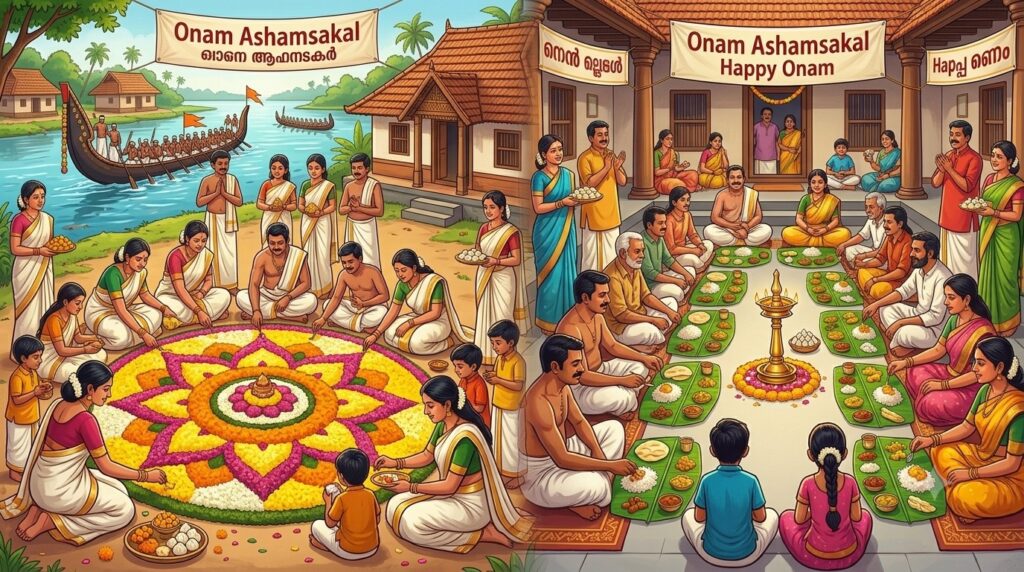
Onam is Kerala’s largest and most widely celebrated festival, a ten-day harvest celebration honoring the mythical King Mahabali, whose annual return home the festival is said to mark.
When is Onam celebrated?
Onam is timed to the Malayalam calendar month of Chingam and centers on the day the moon is in the Thiruvonam Nakshatra, typically placing it in August or September on the Gregorian calendar, with the full festival spanning ten days leading up to it.
This Year's Panchang Details
Wednesday, August 26, 2026
- Tithi
- Tryodashi
- Paksha
- Shukla Paksh
- Nakshatra
- Shravana
- Yoga
- Saubhagya
- Karana
- Taitil
- Hindu Month (Amavasyant)
- Shravana
- Hindu Month (Poornimant)
- Shravana
- Moon Rashi
- Capricon(Makar)
- Sun Rashi
- Leo(Simha)
Why is Onam celebrated?
Onam celebrates the annual homecoming of King Mahabali, a ruler remembered in Kerala’s tradition as just and beloved despite being a demon king (asura) by lineage, and marks the region’s rice harvest with ten days of feasting, games, and cultural performance.
Religious and spiritual significance
Onam holds a distinctive place in Hindu tradition — unlike most festivals, its central figure, Mahabali, is remembered with genuine affection despite being defeated by Vishnu’s avatar Vamana, reflecting a story more about humility and just rule than a straightforward victory of good over evil.
History and background
Onam’s harvest-festival roots and the Mahabali legend are documented extensively in Malayalam and Sanskrit literature, and the festival has grown to function as much as a broader Kerala cultural celebration, observed across religious communities in the state, as a specifically Hindu religious occasion.
Mythological story
The following reflects traditional belief and scripture, not verified historical fact.
According to the story, King Mahabali’s just and prosperous rule made him so beloved that the gods grew concerned about his growing power. Lord Vishnu took the form of Vamana, a humble dwarf Brahmin, and asked Mahabali for as much land as he could cover in three steps. Mahabali, true to his generous nature, agreed. Vamana then grew to cosmic size, covering the earth and sky in two steps, and for the third, Mahabali offered his own head. Moved by his humility and devotion, Vishnu granted Mahabali one wish: to return and visit his people once every year. Onam marks that annual homecoming.
How Onam is traditionally celebrated
- Pookalam — elaborate floral rangoli designs laid at the entrance of homes, growing larger and more intricate each day of the festival.
- Onasadya — a grand vegetarian feast served on a banana leaf, traditionally featuring around two dozen dishes.
- Vallam Kali — traditional snake boat races held on Kerala’s rivers and backwaters, among the festival’s most famous public events.
- Pulikali — folk performers painted as tigers and hunters dance through the streets, especially associated with Thrissur.
Important rituals and customs
- Cleaning and decorating homes ahead of the festival, welcoming Mahabali’s symbolic visit.
- Wearing traditional Kerala attire, especially the cream-and-gold kasavu saree and mundu.
- Community cultural programs featuring classical Kerala dance forms such as Kathakali and Mohiniyattam.
- Exchanging new clothes (Onakodi) with family members.
Regional variations
Onam is celebrated across Kerala and by Malayali communities worldwide, observed broadly across religious lines as a cultural as well as religious festival. Specific customs, particularly the scale of Vallam Kali boat races and Pulikali performances, vary by town and district within the state.
Related Panchang concepts
- Nakshatra — learn about Thiruvonam (Shravana), the lunar mansion Onam’s main day is timed to.
- Hindu Calendar Months — learn about the Hindu lunisolar month cycle Chingam corresponds to.
- Full Year Panchang — look up this year’s date for Onam and every other festival at a glance.
Frequently Asked Questions
Why is a defeated demon king celebrated so fondly at Onam?
Mahabali is remembered in Kerala’s tradition primarily for his just, generous rule and humility, not as a villain — his story emphasizes his character rather than his defeat, which is why his annual symbolic return is celebrated with such warmth.
What is Onasadya?
The grand vegetarian feast central to Onam, traditionally served on a banana leaf and featuring roughly two dozen dishes, eaten on the festival’s main day.
Dates by year: 2025 · 2026 · 2027 · 2028 · 2029 · 2030 · 2031 — all Hindu festival dates