
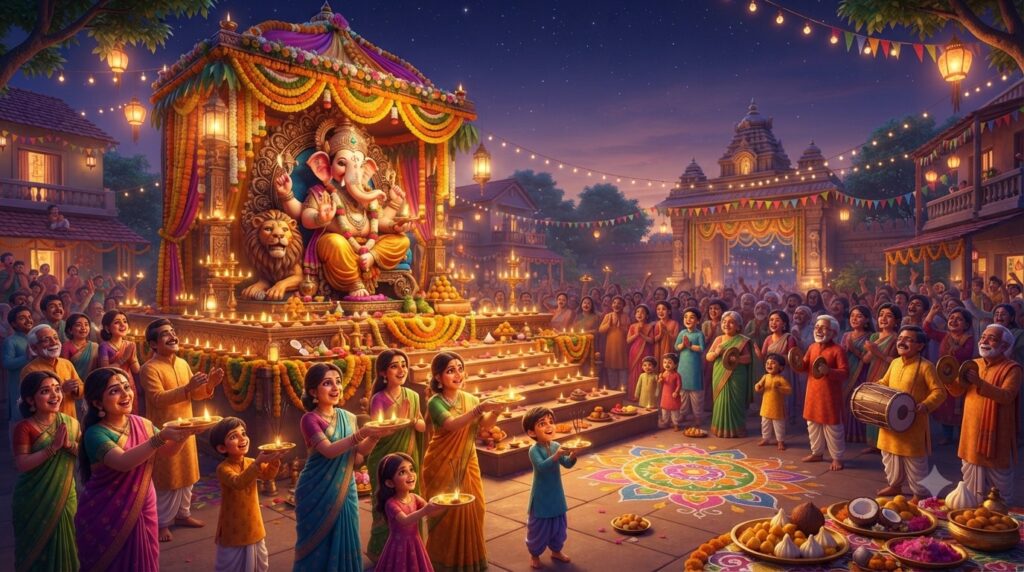
Ganesh Chaturthi celebrates the birth of Lord Ganesha, the elephant-headed god of wisdom, new beginnings, and the remover of obstacles. Homes and public pandals install clay idols of Ganesha for worship over several days, culminating in a public immersion ceremony.
When is Ganesh Chaturthi celebrated?
Ganesh Chaturthi falls on Chaturthi (the fourth Tithi) of Shukla Paksha in the Hindu lunar month of Bhadrapada, typically placing it in August or September on the Gregorian calendar. Observance commonly continues for 1.5, 5, 7, 10, or 11 days depending on family and regional tradition, ending on Anant Chaturdashi.
This Year's Panchang Details
Monday, September 14, 2026
- Tithi
- Tritya
- Paksha
- Shukla Paksh
- Nakshatra
- Chitra
- Yoga
- Brahma
- Karana
- Gar
- Hindu Month (Amavasyant)
- Bhadrapada
- Hindu Month (Poornimant)
- Bhadrapada
- Moon Rashi
- Libra(Tula)
- Sun Rashi
- Leo(Simha)
Why is Ganesh Chaturthi celebrated?
The festival celebrates Ganesha’s birth and his role as the deity worshipped first before any new undertaking, journey, or ceremony in Hindu tradition, since he is regarded as the remover of obstacles (Vighnaharta) and the lord of new beginnings.
Religious and spiritual significance
Ganesha is one of the most widely worshipped deities in Hinduism, invoked at the start of prayers, weddings, business ventures, and other significant undertakings. Installing and worshipping his idol during this festival is seen as inviting his blessing for wisdom, prosperity, and the removal of obstacles in the year ahead.
History and background
While Ganesha worship itself is ancient, the large-scale public celebration familiar today — community pandals, processions, and shared immersion ceremonies — is more recent in its present form. It’s widely documented that the Indian freedom-movement leader Lokmanya Bal Gangadhar Tilak helped popularize public Ganesh Chaturthi celebrations in Maharashtra in the late 19th century as a way to unite communities under colonial rule; the household version of the festival is considerably older.
Mythological story
The following reflects traditional belief and scripture, not verified historical fact.
A widely told account describes how the goddess Parvati created Ganesha from turmeric paste (or clay, in some tellings) to guard her door while she bathed. When Lord Shiva returned and was refused entry by the boy he didn’t recognize as his son, he struck off Ganesha’s head in anger. Realizing his mistake and Parvati’s grief, Shiva ordered his attendants to bring the head of the first creature they found, which turned out to be an elephant, and revived Ganesha with it — the origin, in this telling, of his elephant head.
How Ganesh Chaturthi is traditionally celebrated
- Installing a clay idol of Ganesha at home or in a community pandal, often with elaborate decoration.
- Daily puja and aarti throughout the observance period, with offerings of flowers, incense, and modak (a sweet dumpling considered Ganesha’s favorite).
- Cultural programs, music, and community gatherings around larger public pandals, especially in Maharashtra.
- Visarjan — a closing procession immersing the idol in a river, lake, or the sea, symbolizing Ganesha’s return to his cosmic abode.
Important rituals and customs
- Pranapratishtha — the ritual invoking life into the idol at the start of the festival.
- Offering 21 modaks or durva grass blades, a common devotional practice.
- Reciting the Ganesh Chaturthi Vrat Katha (the traditional story associated with the fast/observance) in many households.
- Community processions with music and dance accompanying the idol to visarjan.
Regional variations
Ganesh Chaturthi is celebrated with particularly large public pandals and processions in Maharashtra (as Ganeshotsav) and Goa. In Karnataka and Andhra Pradesh/Telangana, it’s observed as Vinayaka Chavithi with broadly similar customs. Household-only, quieter observance without large public pandals remains common across much of the rest of India.
Related festivals
Ganesh Chaturthi’s observance period closes with Anant Chaturdashi, the final day of idol immersion for those following the longer 10 or 11-day tradition.
Related Panchang concepts
- Tithi & Paksha — understand the lunar day Ganesh Chaturthi is calculated from (Chaturthi, Shukla Paksha).
- Hindu Calendar Months — learn about Bhadrapada and the rest of the Hindu lunisolar month cycle.
- Full Year Panchang — look up this year’s date for Ganesh Chaturthi and every other festival at a glance.
Frequently Asked Questions
How long does Ganesh Chaturthi last?
It varies by family and region — commonly 1.5, 5, 7, 10, or 11 days, ending with the idol’s immersion (visarjan).
Why is the idol immersed in water at the end?
Visarjan symbolizes Ganesha’s return to his cosmic abode after his visit is complete, and is also tied to the cycle of creation and dissolution central to Hindu ritual practice.
Why are eco-friendly idols encouraged today?
Traditional idols were made from natural clay, but the growing use of plaster-of-Paris and synthetic paints in recent decades raised environmental concerns about immersion in rivers and lakes, leading many communities and authorities to promote a return to clay and natural-dye idols.
Dates by year: 2025 · 2026 · 2027 · 2028 · 2029 · 2030 · 2031 — all Hindu festival dates