
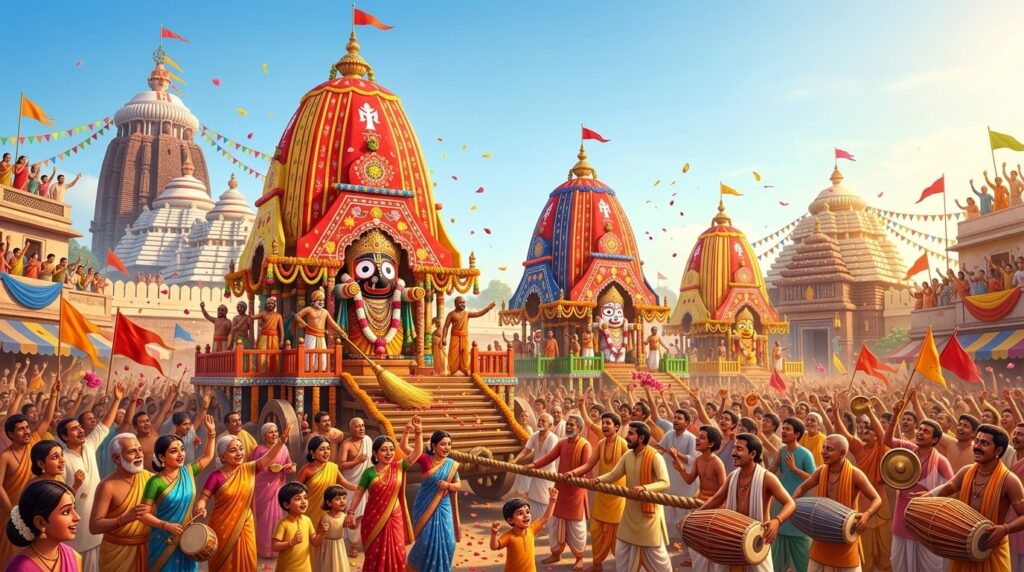
Jagannath Ratha Yatra is a grand chariot procession honoring Lord Jagannath (a form of Krishna/Vishnu), his brother Balabhadra, and sister Subhadra, most famously celebrated at the Jagannath Temple in Puri, Odisha, where enormous wooden chariots are pulled through the streets by thousands of devotees.
When is Jagannath Ratha Yatra celebrated?
Ratha Yatra falls on Dwitiya (the second Tithi) of Shukla Paksha in the Hindu lunar month of Ashadha, typically in June or July on the Gregorian calendar.
This Year's Panchang Details
Thursday, July 16, 2026
- Tithi
- Dvitya
- Paksha
- Shukla Paksh
- Nakshatra
- Ashlesha
- Yoga
- Siddhi
- Karana
- Kaulav
- Hindu Month (Amavasyant)
- Ashadha
- Hindu Month (Poornimant)
- Ashadha
- Moon Rashi
- Cancer(Kark)
- Sun Rashi
- Gemini(Mithun)
Why is Jagannath Ratha Yatra celebrated?
The festival reenacts a symbolic journey of Jagannath, Balabhadra, and Subhadra from the main temple to the Gundicha Temple, traditionally understood as their aunt’s home, giving devotees who cannot normally enter the temple a chance to see and receive the deities’ blessing as the chariots pass through public streets.
Religious and spiritual significance
Ratha Yatra is one of the few major Hindu festivals where the deities leave the temple and enter public space directly, making darshan (a sacred viewing) available to everyone regardless of caste or background — a point of significant historical and social importance in the festival’s tradition.
History and background
The Puri Ratha Yatra is documented across many centuries and is among India’s oldest continuously observed public religious processions, with historical accounts from foreign travelers describing it as far back as the medieval period. The English word “juggernaut” derives from “Jagannath,” referencing the immense scale and momentum of the temple’s chariots.
How Ratha Yatra is traditionally celebrated
- Constructing three massive wooden chariots from scratch each year, using traditional carpentry techniques passed down through dedicated temple craftsman communities.
- Pahandi — a ceremonial procession carrying the deities from the temple to their respective chariots.
- Thousands of devotees pulling the chariots by thick ropes through the streets of Puri toward the Gundicha Temple.
- A return journey, Bahuda Yatra, bringing the deities back to the main temple about a week later.
Important rituals and customs
- Chhera Pahara — a ritual sweeping of the chariots performed by Puri’s traditional ruling authority before the procession begins, symbolizing that all devotees, regardless of status, serve the deities equally.
- Offering Mahaprasad, food prepared in the temple’s kitchens, distributed to enormous crowds during the festival.
- Devotees traveling from across India and abroad specifically for the occasion.
Regional variations
While Puri, Odisha hosts the most famous and largest Ratha Yatra, related Jagannath processions are held in many other Indian cities and, through ISKCON, at temples worldwide, though on a considerably smaller scale than the original.
Related Panchang concepts
- Tithi & Paksha — understand the lunar day Ratha Yatra is calculated from (Dwitiya, Shukla Paksha).
- Hindu Calendar Months — learn about Ashadha and the rest of the Hindu lunisolar month cycle.
- Full Year Panchang — look up this year’s date for Ratha Yatra and every other festival at a glance.
Frequently Asked Questions
Where does the word “juggernaut” come from?
It derives from “Jagannath” — early European travelers, witnessing the immense scale of the temple’s chariots being pulled through Puri’s streets, used it to describe an unstoppable force, and the word entered English with that broader meaning.
Are new chariots built every year?
Yes — all three chariots are constructed from scratch each year by dedicated temple carpenter communities using traditional techniques, rather than being reused.
Dates by year: 2025 · 2026 · 2027 · 2028 · 2029 · 2030 · 2031 — all Hindu festival dates