
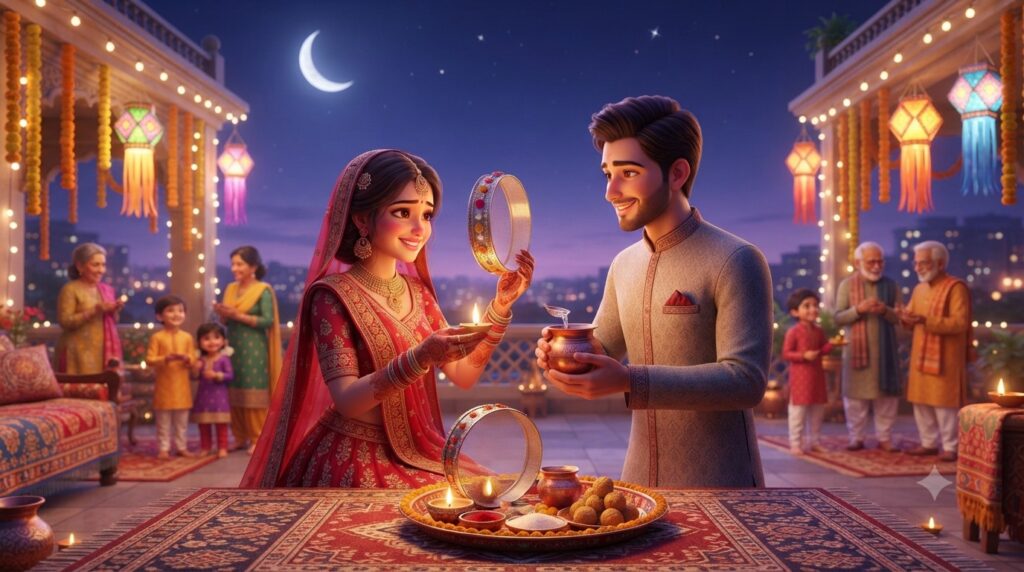
Karva Chauth is a day-long fast observed primarily by married women for the safety, well-being, and long life of their husbands, breaking only after sighting the moon in the evening. It’s most widely observed in North India.
When is Karva Chauth celebrated?
Karva Chauth falls on Chaturthi (the fourth Tithi) of Krishna Paksha in the Hindu lunar month of Kartik, about a week before Diwali, typically in October or November on the Gregorian calendar.
This Year's Panchang Details
Thursday, October 29, 2026
- Tithi
- Chaturthi
- Paksha
- Krishna Paksh
- Nakshatra
- Rohini
- Yoga
- Parigha
- Karana
- Bhav
- Hindu Month (Amavasyant)
- Ashwin
- Hindu Month (Poornimant)
- Kartika
- Moon Rashi
- Taurus(Vrish)
- Sun Rashi
- Libra(Tula)
Why is Karva Chauth celebrated?
The fast is observed as an act of devotion and prayer for a husband’s health, safety, and long life, and, for unmarried women in some traditions, as a prayer for a good future husband.
Religious and spiritual significance
The day centers on Karva Mata and, in many tellings, the goddess Parvati, invoked as witnesses and protectors of marital devotion. The fast itself — typically nirjala, without food or water, from sunrise until moonrise — is treated as the central spiritual practice, an act of discipline and devotion rather than only a ritual formality.
History and background
Karva Chauth’s origins are often linked to the agricultural and social life of Punjab, Haryana, and Rajasthan, where it’s believed to have grown from a broader tradition of women praying for family welfare and, in some historical accounts, for the safe return of husbands during long military campaigns or trade journeys. Its popularity has since spread well beyond these regions, partly through popular media.
Mythological story
The following reflects traditional belief and folk tradition, not verified historical fact.
Several traditional stories are associated with the fast. One widely told account describes a woman named Veeravati (or Karva, in some versions) whose devotion and fast are said to have saved her husband’s life. Another commonly cited story draws a parallel with Savitri, whose devotion and cleverness in the Mahabharata are said to have won her husband Satyavan’s life back from Yama, the god of death — a story invoked more for its theme of devotion than as Karva Chauth’s direct origin.
How Karva Chauth is traditionally celebrated
- Sargi — a pre-dawn meal, traditionally prepared by the woman’s mother-in-law, eaten before the fast begins.
- A full day’s fast without food or water, broken only after moonrise.
- An evening gathering where women listen to or narrate the Karva Chauth Vrat Katha (the traditional story of the fast) together.
- Viewing the moon through a decorative sieve, then viewing the husband’s face through the same sieve, before he offers her water and food to formally break the fast.
Important rituals and customs
- Applying henna (mehndi) in the days before the festival.
- Wearing festive, often red, clothing and traditional jewelry through the day.
- Preparing or receiving a decorated karva (small earthen pot), the item the festival is named for, used in the evening puja.
- Exchanging gifts between the woman and her husband’s family around the observance.
Regional variations
Karva Chauth is most deeply rooted in Punjab, Haryana, Uttar Pradesh, Rajasthan, and Madhya Pradesh. It’s less traditionally observed in South and East India, though its visibility has grown nationally in recent decades, partly through film and television.
Related Panchang concepts
- Tithi & Paksha — understand the lunar day Karva Chauth is calculated from (Chaturthi, Krishna Paksha).
- Hindu Calendar Months — learn about Kartik and the rest of the Hindu lunisolar month cycle.
- Full Year Panchang — look up this year’s date for Karva Chauth and every other festival at a glance.
Frequently Asked Questions
Why is the moon viewed through a sieve on Karva Chauth?
It’s a traditional part of the fast-breaking ritual — the woman views the moon, then her husband, through the same decorative sieve, before he offers her water to formally end the fast.
Is Karva Chauth’s fast observed without any water at all?
Traditionally yes, a strict nirjala (waterless) fast from sunrise to moonrise, though observance strictness varies by individual health and family tradition.
Is Karva Chauth only observed by married women?
It’s most traditionally associated with married women praying for their husbands, though some unmarried women observe it too, praying for a good future spouse, depending on family and regional custom.
Dates by year: 2025 · 2026 · 2027 · 2028 · 2029 · 2030 · 2031 — all Hindu festival dates