
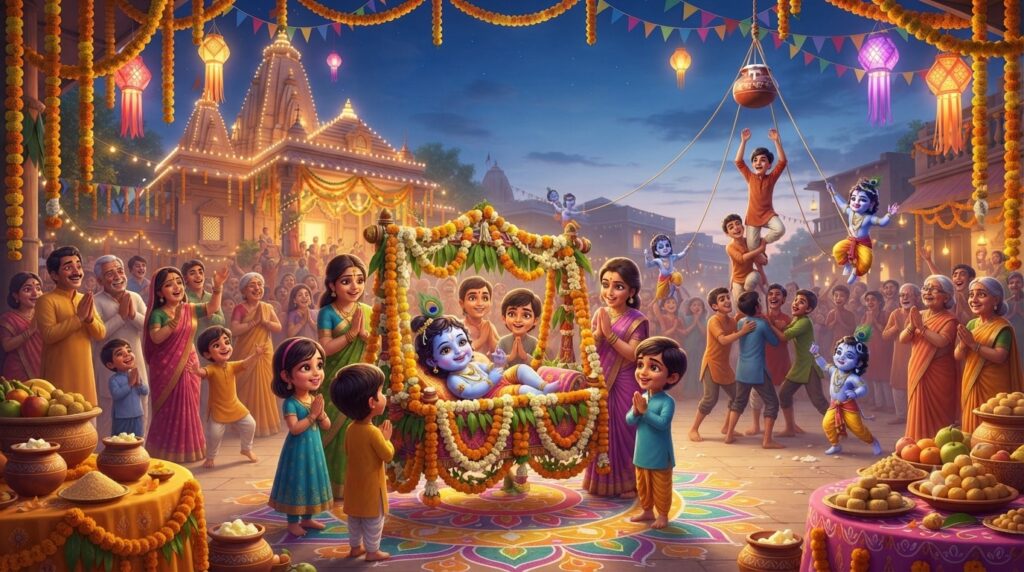
Krishna Janmashtami celebrates the birth of Lord Krishna, one of the most widely worshipped deities in Hinduism and regarded as an avatar of Lord Vishnu. Devotees fast through the day, gather at temples, and celebrate late into the night to mark the moment of his birth.
When is Krishna Janmashtami celebrated?
Janmashtami falls on Ashtami (the eighth Tithi) of Krishna Paksha in the Hindu lunar month of Bhadrapada (called Shravana in the purnimanta month-counting used in parts of North India), typically placing it in August or September on the Gregorian calendar. Tradition holds that Krishna was born at midnight, so the main observance and puja are centered on that hour, and the day is traditionally linked to the Nakshatra Rohini as well.
This Year's Panchang Details
Friday, September 4, 2026
- Tithi
- Astmi
- Paksha
- Krishna Paksh
- Nakshatra
- Rohini
- Yoga
- Harshana
- Karana
- Baalav
- Hindu Month (Amavasyant)
- Shravana
- Hindu Month (Poornimant)
- Bhadrapada
- Moon Rashi
- Taurus(Vrish)
- Sun Rashi
- Leo(Simha)
Why is Janmashtami celebrated?
Janmashtami marks Krishna’s birth and, through it, the broader theme of divine intervention to protect good from tyranny — in scripture, Krishna’s birth is described as arriving specifically to end the oppressive rule of his uncle, the king Kansa.
Religious and spiritual significance
Krishna holds a central place in Hindu devotional (bhakti) tradition, celebrated both as a divine child (Bal Gopal) and, later in his life, as the teacher of the Bhagavad Gita. Janmashtami observance is closely associated with the broader Vaishnavite tradition, including the international ISKCON movement, which treats the day as one of its most significant festivals.
History and background
Krishna’s life and birth are described primarily in the Bhagavata Purana and the Mahabharata, texts whose exact composition dates are debated by scholars but which have shaped devotional practice for well over a thousand years. Public celebration traditions like Dahi Handi are more regionally specific and are generally understood to have developed later as playful reenactments of episodes from Krishna’s childhood.
Mythological story
The following reflects traditional belief and scripture, not verified historical fact.
According to the Bhagavata Purana, King Kansa of Mathura was warned by a prophecy that the eighth child of his sister Devaki would kill him. He imprisoned Devaki and her husband Vasudev and killed each of their children as they were born. When Krishna, their eighth child, was born at midnight, the prison guards fell asleep and its doors miraculously opened. Vasudev carried the infant Krishna across the flooding Yamuna river to Gokul, where he exchanged him for a newborn daughter of Nanda and Yashoda, who raised Krishna in safety away from Kansa’s reach.
How Janmashtami is traditionally celebrated
- Fasting through the day, which many devotees break only after the midnight puja marking Krishna’s birth.
- Decorating temples and home shrines, often with elaborate jhankis (tableaux) depicting scenes from Krishna’s life.
- Devotional singing (bhajans and kirtans) and readings from the Bhagavata Purana leading up to midnight.
- Dahi Handi — in Maharashtra and Gujarat, teams form human pyramids to break a pot of curd hung high above the street, reenacting young Krishna’s playful butter theft.
Important rituals and customs
- Bathing and dressing an idol of the infant Krishna at midnight, then placing him in a decorated cradle.
- Offering foods traditionally associated with Krishna, including milk, butter, and sweets.
- Reciting or listening to the Krishna Janma Katha, the traditional story of his birth.
- Visiting Krishna temples, with especially large gatherings in Mathura, Vrindavan, and Dwarka.
Regional variations
Dahi Handi is most prominent in Maharashtra and Gujarat. Mathura and Vrindavan, traditionally regarded as Krishna’s birthplace and childhood home respectively, host especially elaborate multi-day celebrations. Manipur observes its own classical Ras Lila dance tradition around the festival, and ISKCON temples worldwide hold large Janmashtami gatherings regardless of local cultural background.
Related Panchang concepts
- Tithi & Paksha — understand the lunar day Janmashtami is calculated from (Ashtami, Krishna Paksha).
- Nakshatra — learn about Rohini, the lunar mansion traditionally associated with Krishna’s birth.
- Hindu Calendar Months — learn about Bhadrapada/Shravana and the rest of the Hindu lunisolar month cycle.
- Full Year Panchang — look up this year’s date for Janmashtami and every other festival at a glance.
Frequently Asked Questions
Why is Janmashtami observed at midnight?
Tradition holds that Krishna was born at midnight, so the central puja and the breaking of the day’s fast are timed to that hour.
What is Dahi Handi?
A human-pyramid competition to break a pot of curd hung high above a street, popular in Maharashtra and Gujarat, reenacting stories of young Krishna stealing butter.
Is Janmashtami celebrated on the same date everywhere in India?
Not always exactly — small regional differences in how the Ashtami Tithi is calculated relative to sunrise can occasionally shift the observed date by a day in different traditions.
Dates by year: 2025 · 2026 · 2027 · 2028 · 2029 · 2030 · 2031 — all Hindu festival dates