
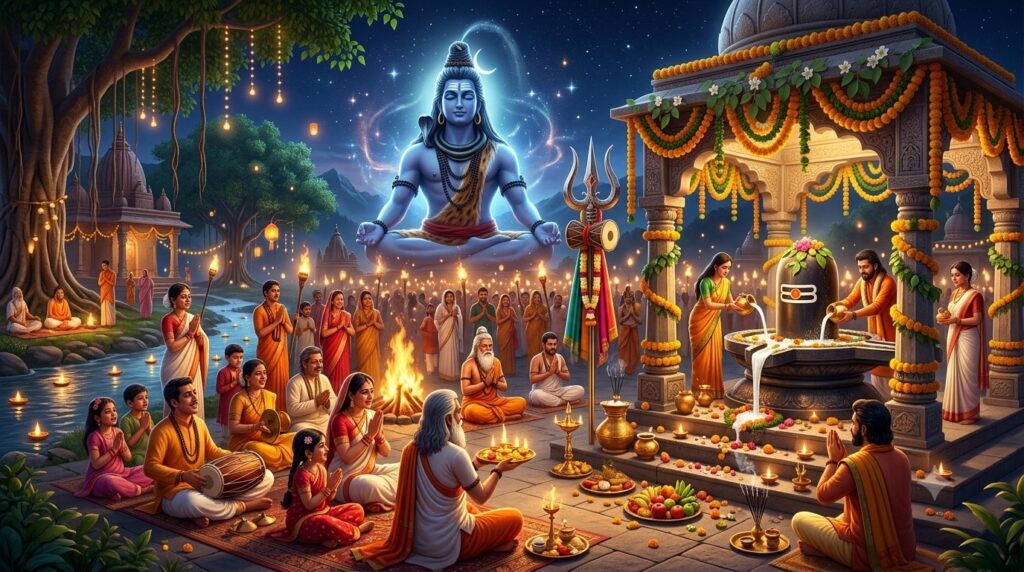
Maha Shivratri, the “Great Night of Shiva,” is one of the most significant festivals honoring Lord Shiva. Devotees observe an all-night vigil, fast, and offer prayers at Shiva temples across India, especially the twelve Jyotirlinga shrines.
When is Maha Shivratri celebrated?
Maha Shivratri falls on Chaturdashi (the fourteenth Tithi) of Krishna Paksha in the Hindu lunar month of Phalgun (called Magha in some regional month-counting systems), typically in February or March on the Gregorian calendar — the darkest night of the lunar cycle, just before the new moon.
This Year's Panchang Details
Sunday, February 15, 2026
- Tithi
- Tryodashi
- Paksha
- Krishna Paksh
- Nakshatra
- UttaraAshadha
- Yoga
- Vyatapata
- Karana
- Vanij
- Hindu Month (Amavasyant)
- Magha
- Hindu Month (Poornimant)
- Phalguna
- Moon Rashi
- Capricon(Makar)
- Sun Rashi
- Aquarius(Kumbh)
Why is Maha Shivratri celebrated?
Different traditions emphasize different reasons for the night’s significance — some regard it as the night of Shiva’s cosmic dance of creation, preservation, and destruction (Tandava); others as the night he married the goddess Parvati; and others as the night he consumed the deadly poison Halahala, churned up from the cosmic ocean, to save creation. These aren’t treated as competing claims so much as layered traditions observed together.
Religious and spiritual significance
Maha Shivratri is considered a night when devotion to Shiva is especially powerful, and is closely associated with meditation, self-discipline, and overcoming darkness — both literal, in the moonless night, and spiritual. Many devotees treat the all-night vigil itself as the central spiritual practice of the festival, not just the rituals performed during it.
History and background
Shiva worship is among the oldest continuous devotional traditions in India, and Maha Shivratri is referenced across multiple Puranas. The specific emphasis given to different mythological explanations for the night has varied by region and sect (particularly within Shaivism) over the centuries, which is why more than one origin story remains in active use today.
Mythological story
The following reflects traditional belief and scripture, not verified historical fact.
One widely told account, from the Samudra Manthan (the churning of the cosmic ocean), describes how gods and demons together churned the ocean in search of the nectar of immortality, but a deadly poison, Halahala, emerged first, threatening to destroy all of creation. Shiva drank the poison to protect the universe, holding it in his throat rather than swallowing it — said to be the origin of his epithet Neelkanth, “the blue-throated one.” A separate, widely told account describes this night as the occasion of Shiva’s marriage to the goddess Parvati, after her long penance won his attention and devotion.
How Maha Shivratri is traditionally celebrated
- An all-night vigil (jagran), often spent at a Shiva temple in prayer, meditation, and devotional singing.
- Fasting through the day and night, ranging from eating only fruit to a strict nirjala (waterless) fast in stricter observance.
- Rudrabhishek — ritually bathing a Shiva lingam with milk, water, honey, yogurt, and other offerings across the night’s four traditional prayer watches (prahars).
- Offering bel (bilva) leaves, considered especially dear to Shiva.
- Chanting “Om Namah Shivaya” and reciting the Shiva Purana or Shiva Chalisa.
Important rituals and customs
- Visiting a Shiva temple, with especially large gatherings at the twelve Jyotirlinga shrines across India.
- Performing Rudrabhishek at each of the night’s four prahars, each with its own prescribed offerings in stricter observance.
- Breaking the fast the following morning after the vigil concludes.
Regional variations
The twelve Jyotirlinga temples, including Kashi Vishwanath in Varanasi and Mahakaleshwar in Ujjain, see especially large gatherings. In parts of South India, the night is linked more closely to Shiva’s cosmic dance and Nataraja worship, particularly around Chidambaram. Observance style also varies by sect within Shaivism, though the core all-night vigil is broadly shared across regions.
Related Panchang concepts
- Tithi & Paksha — understand the lunar day Maha Shivratri is calculated from (Chaturdashi, Krishna Paksha).
- Hindu Calendar Months — learn about Phalgun/Magha and the rest of the Hindu lunisolar month cycle.
- Full Year Panchang — look up this year’s date for Maha Shivratri and every other festival at a glance.
Frequently Asked Questions
Why is Maha Shivratri observed at night rather than during the day?
The festival falls on the darkest night of the lunar month, and the all-night vigil itself — staying awake in prayer and meditation through that darkness — is considered central to its spiritual practice, not just a scheduling detail.
What is Rudrabhishek?
A ritual bathing of a Shiva lingam with offerings such as milk, water, honey, and yogurt, typically repeated across the night’s four traditional prayer watches.
Is Maha Shivratri the same as the monthly Shivratri?
No. A Shivratri (Chaturdashi of Krishna Paksha) occurs every lunar month, but Maha Shivratri, in the month of Phalgun/Magha, is regarded as the most significant of these and the one marked with the full festival’s observance.
Dates by year: 2025 · 2026 · 2027 · 2028 · 2029 · 2030 — all Hindu festival dates