
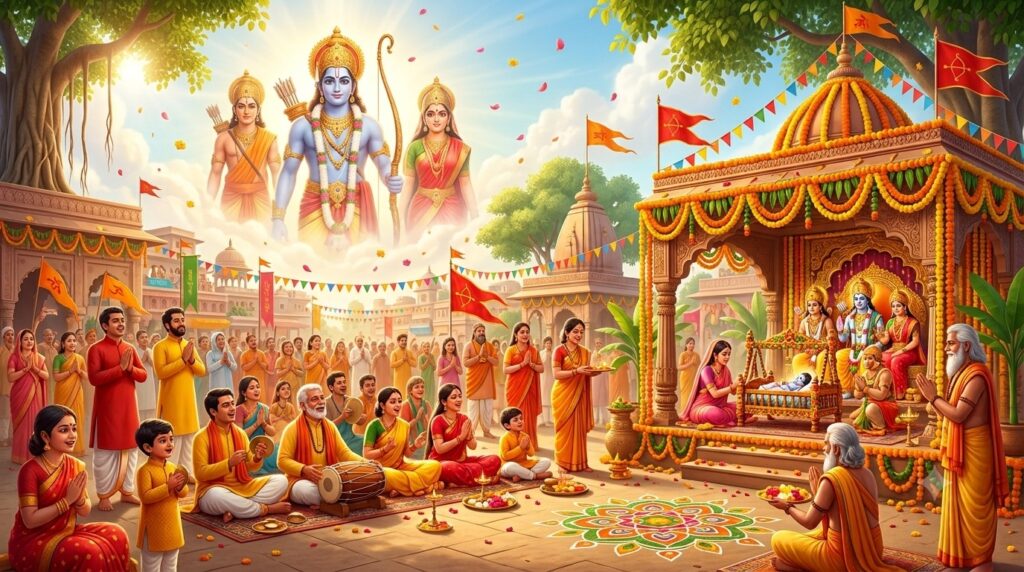
Ram Navami celebrates the birth of Lord Rama, the seventh avatar of Vishnu and central figure of the Ramayana, revered as an ideal of righteousness, duty, and devotion.
When is Ram Navami celebrated?
Ram Navami falls on Navami (the ninth Tithi) of Shukla Paksha in the Hindu lunar month of Chaitra, typically in March or April on the Gregorian calendar, marking the ninth and final day of Chaitra Navratri.
This Year's Panchang Details
Thursday, March 26, 2026
- Tithi
- Astmi
- Paksha
- Shukla Paksh
- Nakshatra
- Ardra
- Yoga
- Sobhana
- Karana
- Bhav
- Hindu Month (Amavasyant)
- Chaitra
- Hindu Month (Poornimant)
- Chaitra
- Moon Rashi
- Gemini(Mithun)
- Sun Rashi
- Pisces(Meen)
Why is Ram Navami celebrated?
The day celebrates Rama’s birth to King Dasharatha and Queen Kausalya of Ayodhya, an event scripture describes as arriving specifically to restore dharma (righteousness) and defeat the demon king Ravana’s growing tyranny.
Religious and spiritual significance
Rama is regarded as the ideal of dharma — the perfect son, husband, king, and devotee — and Ram Navami is treated as an occasion for reflecting on those values as much as celebrating his birth itself. The Ramayana’s teachings are widely read and discussed in the days surrounding the festival.
History and background
Rama’s life is described in the Ramayana, traditionally attributed to the sage Valmiki, one of the two great Hindu epics alongside the Mahabharata. Ram Navami’s observance as a distinct festival, alongside continuous Ramayana recitation traditions, is documented across many centuries of devotional practice.
Mythological story
The following reflects traditional belief and scripture, not verified historical fact.
According to the Ramayana, King Dasharatha of Ayodhya, initially without an heir, performed a special yajna (fire ritual) after which his three wives bore him four sons. Rama, born to Queen Kausalya, was later understood to be an avatar of Vishnu, born specifically to defeat the demon king Ravana, whose tyranny threatened both gods and mortals.
How Ram Navami is traditionally celebrated
- Reciting or listening to the Ramayana, especially the Ramcharitmanas, in the days leading up to and on the festival itself.
- Visiting Rama temples, with especially large gatherings in Ayodhya, traditionally regarded as his birthplace.
- Fasting through the day in many households, broken at noon — the traditional hour of his birth.
- Processions (shobha yatras) featuring performers dressed as Rama, Sita, Lakshmana, and Hanuman in many cities.
Important rituals and customs
- Decorating home shrines and temples with flowers and Rama’s image or idol.
- Preparing and sharing panakam (a jaggery-and-pepper drink) and other seasonal offerings in South India.
- Kalyanotsavam — a ceremonial reenactment of Rama and Sita’s wedding, especially significant in South Indian temples.
Regional variations
Ram Navami is observed with particular scale in Ayodhya, Rama’s traditional birthplace, and across much of North India with large public processions. In Andhra Pradesh and Telangana, the day is closely associated with Sita Rama Kalyanam, a temple reenactment of Rama and Sita’s wedding.
Related Panchang concepts
- Tithi & Paksha — understand the lunar day Ram Navami is calculated from (Navami, Shukla Paksha).
- Hindu Calendar Months — learn about Chaitra and the rest of the Hindu lunisolar month cycle.
- Full Year Panchang — look up this year’s date for Ram Navami and every other festival at a glance.
Frequently Asked Questions
Why is the Ram Navami fast broken at noon?
Noon is traditionally regarded as the hour of Rama’s birth, so many households time the day’s fast to break at that point.
Is Ram Navami connected to Navratri?
Yes — it falls on the ninth and final day of Chaitra Navratri (distinct from the better-known autumn Sharad Navratri), which begins with its own Ghatasthapana-style opening ritual roughly a week earlier.
Dates by year: 2025 · 2026 · 2027 · 2028 · 2029 · 2030 · 2031 — all Hindu festival dates