
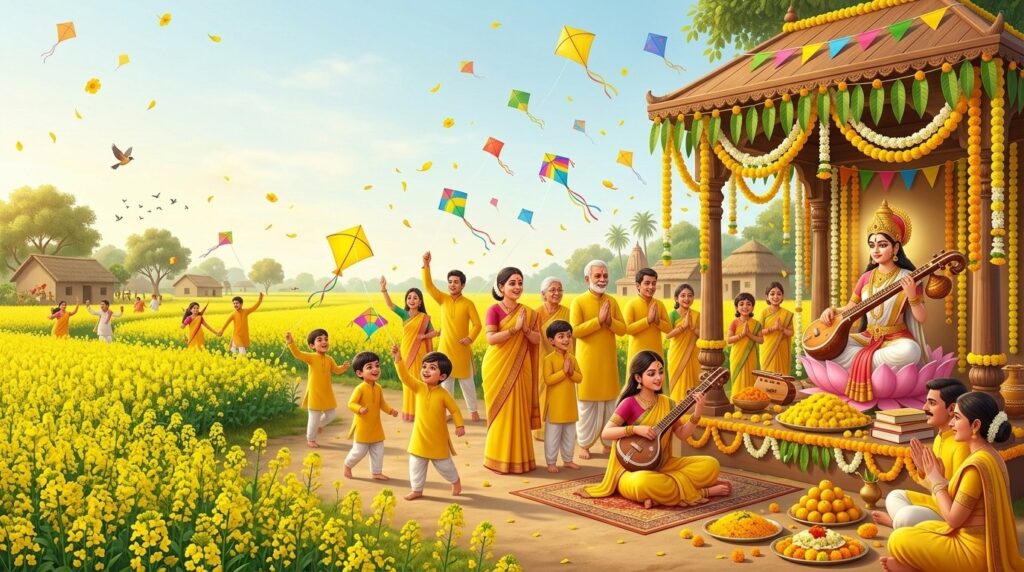
Vasant Panchami marks the arrival of spring and is dedicated to Goddess Saraswati, the deity of knowledge, music, and the arts. Students, musicians, and artists mark the day with special reverence.
When is Vasant Panchami celebrated?
Vasant Panchami falls on Panchami (the fifth Tithi) of Shukla Paksha in the Hindu lunar month of Magh, typically in January or February on the Gregorian calendar, traditionally regarded as the first day of spring.
This Year's Panchang Details
Friday, January 23, 2026
- Tithi
- Panchmi
- Paksha
- Shukla Paksh
- Nakshatra
- PurvaBhadrapada
- Yoga
- Parigha
- Karana
- Bhav
- Hindu Month (Amavasyant)
- Magha
- Hindu Month (Poornimant)
- Magha
- Moon Rashi
- Aquarius(Kumbh)
- Sun Rashi
- Capricon(Makar)
Why is Vasant Panchami celebrated?
The day celebrates both the seasonal shift into spring, with mustard fields blooming yellow across much of North India, and the worship of Saraswati as the source of wisdom, learning, and artistic creativity.
Religious and spiritual significance
Vasant Panchami is considered especially auspicious for beginning a child’s education, starting new creative or artistic pursuits, and for worship connected to speech, music, and learning. Yellow, the color of blooming mustard flowers and of ripening grain, is closely associated with the day.
History and background
References to Vasant (spring) as a season of celebration appear throughout classical Sanskrit literature, and Saraswati’s association with this particular day is documented across multiple regional traditions, especially strong in eastern and northern India.
Mythological story
The following reflects traditional belief and scripture, not verified historical fact.
Saraswati is described in various Puranic accounts as the goddess who gave the power of speech and knowledge to the newly created world, and Vasant Panchami is widely observed as marking her appearance or her particular blessing of learning and the arts.
How Vasant Panchami is traditionally celebrated
- Worshipping Goddess Saraswati at home, temples, and especially schools, often with books, musical instruments, and writing tools placed before her idol or image.
- Vidyarambham — formally beginning a young child’s education by having them write their first letters, considered especially auspicious on this day in several traditions.
- Wearing yellow clothing and preparing yellow-colored foods such as saffron rice or besan-based sweets.
- Flying kites in parts of North India, alongside general spring celebrations.
Important rituals and customs
- Placing books, pens, and musical instruments near the Saraswati idol overnight before worship, in the belief that they receive her blessing.
- Offering yellow flowers, particularly marigold, during puja.
- Community Saraswati Puja pandals in parts of East India, similar in style to Durga Puja pandals.
Regional variations
Vasant Panchami is observed with particular prominence in Punjab, where it’s tied to kite-flying and mustard-field spring celebrations, and in West Bengal, Bihar, and Assam, where large community Saraswati Puja gatherings, especially in schools and colleges, are common.
Related Panchang concepts
- Tithi & Paksha — understand the lunar day Vasant Panchami is calculated from (Panchami, Shukla Paksha).
- Hindu Calendar Months — learn about Magh and the rest of the Hindu lunisolar month cycle.
- Full Year Panchang — look up this year’s date for Vasant Panchami and every other festival at a glance.
Frequently Asked Questions
Why is yellow associated with Vasant Panchami?
Yellow reflects the blooming mustard fields of the spring season and ripening grain, and is also considered Saraswati’s favored color on this day.
What is Vidyarambham?
The ritual of formally beginning a young child’s education, often by guiding their hand to write their first letters, considered especially auspicious on Vasant Panchami.
Dates by year: 2025 · 2026 · 2027 · 2028 · 2029 · 2030 · 2031 — all Hindu festival dates