
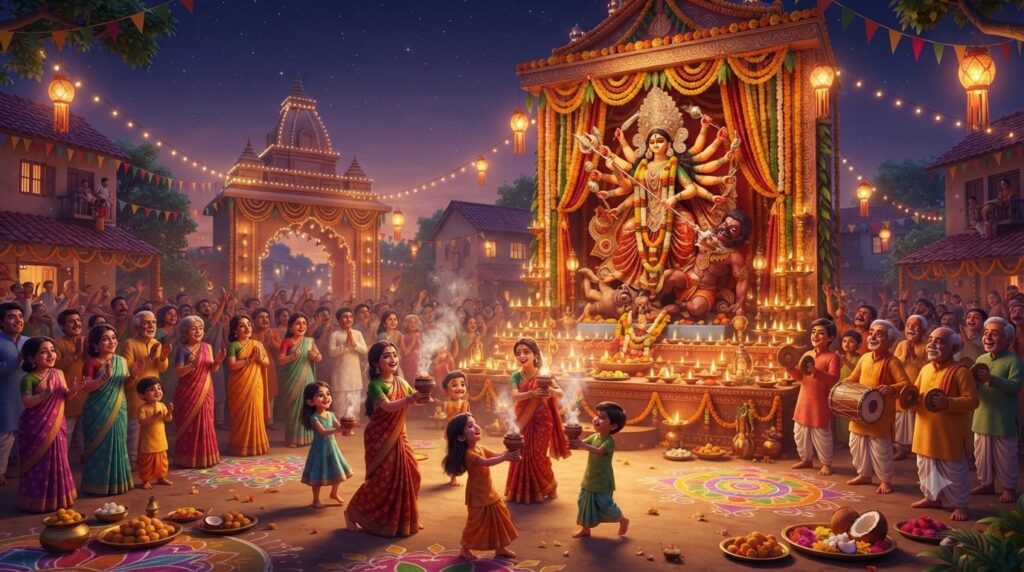
Ghatasthapana marks the opening ritual of Sharad Navratri, the nine-night autumn festival honoring the goddess Durga in her many forms. The word itself means “establishing the pot” — referring to the sacred vessel installed on this day to begin the nine days of worship.
When is Ghatasthapana observed?
Ghatasthapana takes place on Pratipada (the first Tithi) of Shukla Paksha in the Hindu lunar month of Ashwin, marking day one of Sharad Navratri, typically in September or October on the Gregorian calendar. The exact auspicious window (muhurat) within that day is traditionally significant for performing the ritual.
This Year's Panchang Details
Sunday, October 11, 2026
- Tithi
- Prathama
- Paksha
- Shukla Paksh
- Nakshatra
- Chitra
- Yoga
- Vaidhriti
- Karana
- Kimstunga
- Hindu Month (Amavasyant)
- Ashwin
- Hindu Month (Poornimant)
- Ashwin
- Moon Rashi
- Virgo(Kanya)
- Sun Rashi
- Virgo(Kanya)
Why is Ghatasthapana performed?
Ghatasthapana formally opens the nine-day worship of the goddess by inviting her presence into a sacred vessel (ghata or kalash), which then remains at the center of daily puja throughout Navratri. It is considered essential groundwork for the rest of the festival’s observance.
Religious and spiritual significance
The ritual establishes a consecrated space for the goddess for the duration of Navratri, and is closely tied to agricultural symbolism: barley or wheat seeds are commonly sown in a small tray beside the kalash and watered daily, their sprouting by the festival’s end read as a sign of the goddess’s blessing and the fertility of the coming season.
History and background
Ghatasthapana is documented across multiple traditional Hindu ritual texts as the prescribed opening of Navratri worship, and the kalash-as-sacred-vessel tradition itself is far older, appearing across many different Hindu rituals beyond Navratri specifically. Its precise regional form varies with local Devi-worship traditions.
How Ghatasthapana is traditionally performed
- Cleaning and preparing the puja space, often with a layer of soil in a wide tray for sowing barley or wheat seeds.
- Filling a clay or metal kalash with water (sometimes mixed with Ganga water where available), and placing mango leaves around its neck.
- Placing a coconut, often wrapped in a red cloth, atop the kalash.
- Installing the completed kalash on the seed tray, inviting the goddess’s presence for the nine days ahead.
- Lighting an akhand jyot (unbroken lamp) beside it in many households, kept burning throughout Navratri.
Important rituals and customs
- Performing the ritual within the specific muhurat considered auspicious for that year, where observed.
- Daily watering of the sown seeds and daily puja to the kalash throughout the nine nights.
- Reciting Durga-related scripture, such as portions of the Devi Mahatmya, alongside the ritual in many traditions.
Regional variations
The specific form of Ghatasthapana varies by region and family tradition — some households sow seeds in a separate tray beside the kalash, others include them inside it; the choice of grain, the exact items placed atop the kalash, and the accompanying chants all differ across communities. This reflects the wide diversity of Devi-worship traditions across India rather than a single fixed procedure.
Related festivals
Ghatasthapana is specifically the opening ritual of the broader Navratri festival — for the full nine-night celebration, its forms across India, and its closing days, see our dedicated Navratri article. Navratri closes with Vijayadashami (Dussehra), observed the day after the ninth night.
Related Panchang concepts
- Tithi & Paksha — understand the lunar day Ghatasthapana is calculated from (Pratipada, Shukla Paksha).
- Hindu Calendar Months — learn about Ashwin and the rest of the Hindu lunisolar month cycle.
- Full Year Panchang — look up this year’s date for Ghatasthapana and every other festival at a glance.
Frequently Asked Questions
Is Ghatasthapana a separate festival from Navratri?
Not exactly — it’s the specific opening ritual that begins Navratri, performed on the first of its nine days, rather than a distinct festival of its own.
What happens if Ghatasthapana’s Tithi doesn’t fall on a particular date in a given year?
On rare occasions a Tithi can be skipped entirely in sunrise-based calendar reckoning (see our Tithi & Paksha page for how this works) — when that happens for the relevant Tithi, this page’s yearly detail section will show that no date is available rather than an incorrect one.
Why are seeds sown as part of the ritual?
The sown barley or wheat, watered daily through Navratri, is traditionally read as a sign of the goddess’s blessing and the fertility of the season ahead.
Dates by year: 2025 · 2026 · 2027 · 2028 · 2029 · 2030 · 2031 — all Hindu festival dates