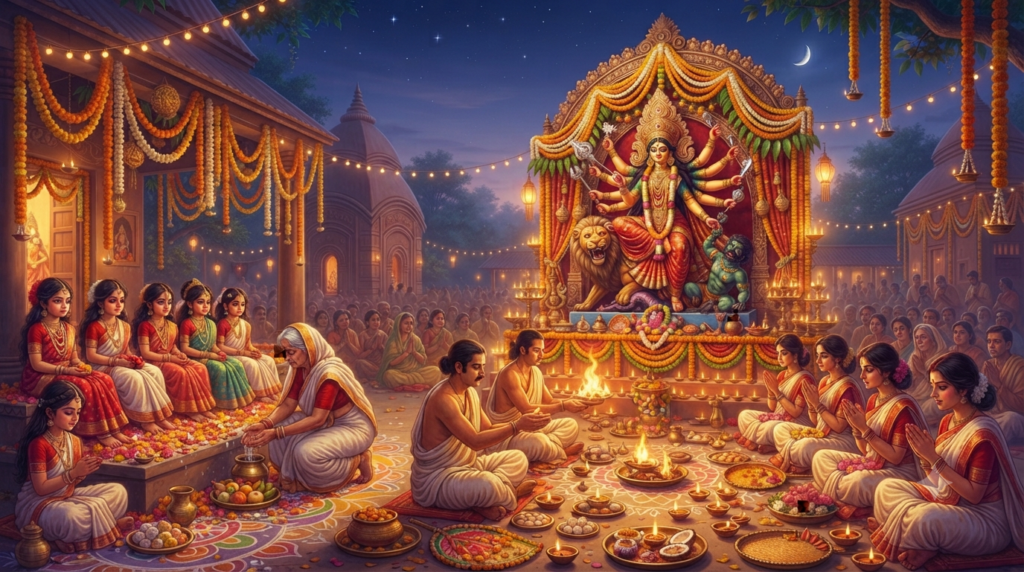
Durga Ashtami, also called Maha Ashtami, is the eighth day of Sharad Navratri and one of its most significant, marked by elaborate Durga Puja observance and, in many Bengali traditions, the single most important day of the entire festival.
When is Durga Ashtami celebrated?
Durga Ashtami falls on Ashtami (the eighth Tithi) of Shukla Paksha in the Hindu lunar month of Ashwin, on the eighth day of Navratri, typically in September or October on the Gregorian calendar. The brief junction between Ashtami and the following Navami Tithi — known as Sandhi Puja — is considered especially auspicious.
This Year's Panchang Details
Monday, October 19, 2026
- Tithi
- Astmi
- Paksha
- Shukla Paksh
- Nakshatra
- UttaraAshadha
- Yoga
- Dhriti
- Karana
- Bhav
- Hindu Month (Amavasyant)
- Ashwin
- Hindu Month (Poornimant)
- Ashwin
- Moon Rashi
- Capricon(Makar)
- Sun Rashi
- Libra(Tula)
Why is Durga Ashtami celebrated?
The day honors the goddess Durga at a decisive point in her battle against the buffalo demon Mahishasura, and is widely understood as marking the moment her power is at its peak before the battle’s conclusion the following day.
Religious and spiritual significance
Ashtami is treated in many traditions as the day the goddess’s fierce, victorious form is most directly worshipped. In several communities, young girls are honored as living representations of the goddess through Kumari Puja, reflecting the belief that divine feminine energy (Shakti) can be present in any girl or woman.
History and background
Durga Ashtami’s prominence, especially the elaborate pandal-based public worship associated with Bengali Durga Puja, developed and grew substantially from roughly the 16th–18th centuries onward through wealthy patronage, later expanding into today’s large community-organized celebrations; the underlying Ashtami worship of the goddess is considerably older.
Mythological story
The following reflects traditional belief and scripture, not verified historical fact.
According to the Devi Mahatmya, the demon Mahishasura had received a boon making him nearly invincible to gods and men. The goddess Durga was created from the combined energies of the major gods specifically to defeat him, riding into battle on a lion. Her fiercest, most powerful battle forms — including Chamunda, who is said to have destroyed the demons Chanda and Munda during this period — are traditionally associated with the intensity of Ashtami.
How Durga Ashtami is traditionally celebrated
- Elaborate Durga Puja rituals at home shrines and community pandals, with special offerings and chanting.
- Sandhi Puja — a short, precisely timed ritual spanning the last 24 minutes of Ashtami and the first 24 minutes of Navami, regarded as one of the most powerful moments of the entire festival.
- Kumari Puja — ritual worship of a young girl as a living embodiment of the goddess, observed in many Bengali and some other regional traditions.
- Cultural programs, communal feasting, and pandal-hopping in cities with large public Durga Puja celebrations.
Important rituals and customs
- Offering 108 lotus flowers and 108 lamps during Sandhi Puja in many traditions.
- Animal or symbolic sacrifice in some traditional communities, though many households today use a symbolic substitute such as a vegetable or sweet.
- Continued daily worship of the kalash established on Ghatasthapana.
Regional variations
Durga Ashtami is celebrated with particular scale and public grandeur in West Bengal, where Durga Puja is the region’s largest festival, alongside significant observance in Assam, Odisha, and Bihar. In much of North India, the same day is observed more simply as part of the broader nine-day Navratri fast, often alongside Kanya Puja customs shared with Maha Navami.
Related festivals
Durga Ashtami is the eighth day of Navratri, which begins with Ghatasthapana and continues into Maha Navami and Dussehra.
Related Panchang concepts
- Tithi & Paksha — understand the lunar day Durga Ashtami is calculated from (Ashtami, Shukla Paksha).
- Hindu Calendar Months — learn about Ashwin and the rest of the Hindu lunisolar month cycle.
- Full Year Panchang — look up this year’s date for Durga Ashtami and every other festival at a glance.
Frequently Asked Questions
What is Sandhi Puja?
A brief, precisely timed ritual performed across the exact junction of the Ashtami and Navami Tithis, regarded in many Durga Puja traditions as one of the most spiritually potent moments of Navratri.
What is Kumari Puja?
The ritual worship of a young girl, honored as a living embodiment of the goddess’s energy, observed on Ashtami or Navami in several regional traditions.
Dates by year: 2025 · 2026 · 2027 · 2028 · 2029 · 2030 · 2031 — all Hindu festival dates