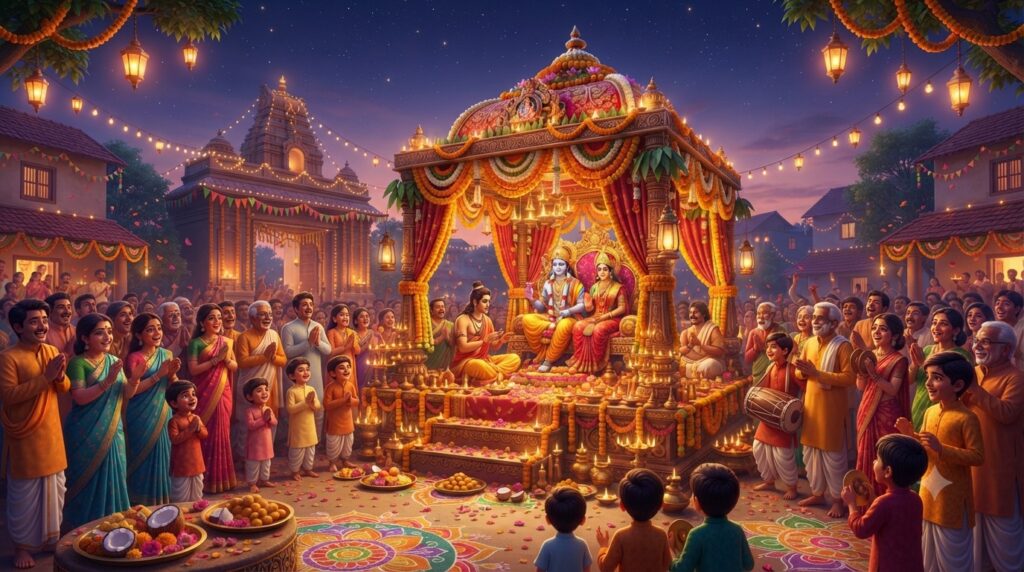
Vivah Panchami commemorates the wedding of Lord Rama and Sita, celebrated with particular devotion in Ayodhya and Janakpur, the cities scripture associates with the groom and bride respectively.
When is Vivah Panchami celebrated?
Vivah Panchami falls on Panchami (the fifth Tithi) of Shukla Paksha in the Hindu lunar month of Margashirsha, typically in November or December on the Gregorian calendar.
This Year's Panchang Details
Monday, December 14, 2026
- Tithi
- Panchmi
- Paksha
- Shukla Paksh
- Nakshatra
- Shravana
- Yoga
- Vyagatha
- Karana
- Baalav
- Hindu Month (Amavasyant)
- Margashirsha
- Hindu Month (Poornimant)
- Margashirsha
- Moon Rashi
- Capricon(Makar)
- Sun Rashi
- Scorpio(Vrischik)
Why is Vivah Panchami celebrated?
The day commemorates Rama and Sita’s wedding as told in the Ramayana, celebrated as an ideal of marital devotion and virtue, and is marked with temple reenactments of the ceremony itself.
Religious and spiritual significance
Rama and Sita’s marriage is held up in Hindu tradition as an example of ideal partnership, and Vivah Panchami is treated by many devotees as a day to reflect on those values, alongside continued devotion to Rama connected to the earlier festival of Ram Navami, which celebrates his birth.
History and background
The wedding is described in the Bala Kanda, the first book of Valmiki’s Ramayana, and Vivah Panchami’s observance as a specific festival, alongside grand annual reenactments particularly in Janakpur, Nepal, and Ayodhya, is documented across a long tradition of Rama devotion.
Mythological story
The following reflects traditional belief and scripture, not verified historical fact.
According to the Ramayana, King Janaka of Mithila held a swayamvara (a ceremony where a bride’s husband is chosen through a contest) for his daughter Sita, requiring any suitor to string an immense, ancient bow that had belonged to Lord Shiva. Where other princes and kings failed, Rama not only strung the bow but broke it in the process, winning Sita’s hand. Their subsequent wedding in Mithila (Janakpur) is what Vivah Panchami commemorates.
How Vivah Panchami is traditionally celebrated
- Elaborate temple reenactments of the Rama-Sita wedding ceremony, with idols or performers dressed as the bride and groom.
- Recitation of the wedding episode from the Ramayana or Ramcharitmanas.
- Large annual celebrations and pilgrimage gatherings in Janakpur, Nepal, believed to be ancient Mithila, and in Ayodhya.
- Devotional singing and processions in temples across North India.
Important rituals and customs
- Decorating temples elaborately in wedding style, with floral mandaps and ceremonial attire on the deities.
- Devotees from India and Nepal traveling specifically to Janakpur for the occasion, where the celebration is especially significant.
- Fasting or attending special satsangs (devotional gatherings) through the day in many households.
Regional variations
Vivah Panchami is observed with particular scale in Janakpur, Nepal, and Ayodhya, the cities most closely associated with Sita and Rama respectively, with large cross-border pilgrimage traffic between the two during the festival. Elsewhere in North India, it’s typically marked with temple ceremonies rather than large public gatherings.
Related festivals
Vivah Panchami continues the devotional cycle connected to Ram Navami, which celebrates Rama’s birth earlier in the year.
Related Panchang concepts
- Tithi & Paksha — understand the lunar day Vivah Panchami is calculated from (Panchami, Shukla Paksha).
- Hindu Calendar Months — learn about Margashirsha and the rest of the Hindu lunisolar month cycle.
- Full Year Panchang — look up this year’s date for Vivah Panchami and every other festival at a glance.
Frequently Asked Questions
Why is Janakpur especially significant for Vivah Panchami?
Janakpur, in present-day Nepal, is traditionally identified as ancient Mithila, King Janaka’s kingdom and Sita’s birthplace — the city where the Ramayana describes their wedding taking place.
How is Vivah Panchami related to Ram Navami?
Ram Navami celebrates Rama’s birth, while Vivah Panchami, later in the year, commemorates his wedding to Sita — both are part of the wider devotional calendar built around his life story.
Dates by year: 2025 · 2026 · 2027 · 2028 · 2029 · 2030 · 2031 — all Hindu festival dates