
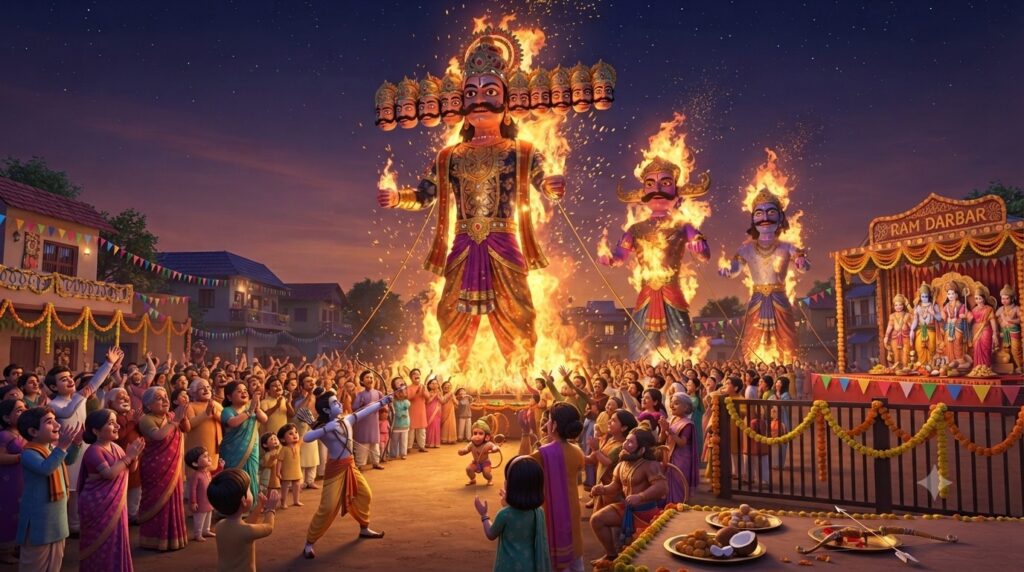
Dussehra, also called Vijayadashami, celebrates the triumph of good over evil — most widely told through Lord Rama’s victory over the demon king Ravana, and, in Bengal and much of East India, through the conclusion of Durga’s battle against Mahishasura. It’s one of the most widely celebrated festivals across India, with dramatically different customs from region to region.
When is Dussehra celebrated?
Dussehra falls on Dashami (the tenth Tithi) of Shukla Paksha in the Hindu lunar month of Ashwin, the day immediately after Navratri’s ninth night, typically in September or October on the Gregorian calendar.
This Year's Panchang Details
Tuesday, October 20, 2026
- Tithi
- Navami
- Paksha
- Shukla Paksh
- Nakshatra
- Shravana
- Yoga
- Soola
- Karana
- Kaulav
- Hindu Month (Amavasyant)
- Ashwin
- Hindu Month (Poornimant)
- Ashwin
- Moon Rashi
- Capricon(Makar)
- Sun Rashi
- Libra(Tula)
Why is Dussehra celebrated?
Dussehra marks the victory of good over evil, told through two major, regionally distinct threads: Rama’s defeat of Ravana after a long exile and war, and the goddess Durga’s defeat of Mahishasura at the close of Navratri. Both stories share the same underlying theme, celebrated on the same day.
Religious and spiritual significance
In North India, Dussehra is closely tied to the Ramayana and is treated as a decisive moment of righteousness (dharma) prevailing over tyranny. In Bengal and much of East India, the day instead completes the Durga Puja cycle, marking the goddess’s farewell as her idol is ceremonially immersed. The name “Vijayadashami” itself means “the victorious tenth.”
History and background
Public Ramlila performances and Ravana-effigy burning, now closely associated with North Indian Dussehra, are documented as having grown into today’s large-scale form over several centuries, with royal patronage in cities like Mysuru shaping the grand public celebrations still seen there today. The Durga-immersion tradition central to Bengal’s observance developed alongside the broader growth of public Durga Puja described on our Durga Ashtami page.
Mythological story
The following reflects traditional belief and scripture, not verified historical fact.
In the Ramayana, Ravana, the demon king of Lanka, abducted Rama’s wife Sita. After a long search and a great war, Rama, with the help of his brother Lakshmana and the monkey-god Hanuman’s army, defeated Ravana and rescued Sita. Dussehra marks the day of that final victory, later followed by Rama’s celebrated return to Ayodhya at Diwali. Separately, in the Devi Mahatmya, this is the day the goddess Durga’s nine-day battle against the demon Mahishasura concludes in his defeat.
How Dussehra is traditionally celebrated
- Ravana Dahan — burning large effigies of Ravana, along with his brother Kumbhakarna and son Meghnad, often at the climax of a public Ramlila performance.
- Durga visarjan — in Bengal and much of East India, the Durga idol is taken in procession and immersed in a river or other body of water, accompanied by sindoor khela, where married women apply vermilion to the goddess and each other.
- Continuation of Ayudha Puja customs from Maha Navami in parts of South India.
- Vidyarambha — in parts of South India, especially Kerala, initiating young children into learning to write is considered auspicious on this day.
Important rituals and customs
- Attending or watching the climax of a Ramlila performance before the effigy burning.
- Exchanging Shami leaves as a symbol of goodwill in some North Indian traditions.
- Farewell rituals and blessings from elders, since the day is traditionally considered auspicious for new beginnings.
Regional variations
Mysuru Dasara in Karnataka is one of India’s grandest public celebrations, featuring a royal procession with decorated elephants dating back to the erstwhile Wadiyar dynasty. Kullu Dussehra in Himachal Pradesh centers on a large gathering of local deities rather than Ravana-effigy burning. Bengal’s Vijaya Dashami is built entirely around Durga’s farewell and immersion rather than the Rama-Ravana narrative. This list reflects commonly cited regional patterns rather than an exhaustive account.
Related festivals
Dussehra is the tenth and final day of the Navratri cycle, following Ghatasthapana, Durga Ashtami, and Maha Navami. In North India, it also marks 20 days before Diwali, the two festivals traditionally regarded as bookends of the same Rama-Ayodhya story.
Related Panchang concepts
- Tithi & Paksha — understand the lunar day Dussehra is calculated from (Dashami, Shukla Paksha).
- Hindu Calendar Months — learn about Ashwin and the rest of the Hindu lunisolar month cycle.
- Full Year Panchang — look up this year’s date for Dussehra and every other festival at a glance.
Frequently Asked Questions
Is Dussehra the same as Vijayadashami?
Yes, they’re the same festival — “Dussehra” is the more common everyday name, while “Vijayadashami” (“the victorious tenth”) is its formal Sanskrit name.
Why are Ravana effigies burned on Dussehra?
The burning symbolizes the destruction of evil and the triumph of Rama’s righteousness over Ravana’s tyranny, the central story behind North India’s Dussehra observance.
How many days after Dussehra is Diwali?
Twenty days, in the traditional Rama-Ayodhya narrative that links the two festivals — Dussehra marks his victory over Ravana, and Diwali marks his return home to Ayodhya.
Dates by year: 2025 · 2026 · 2027 · 2028 · 2029 · 2030 · 2031 — all Hindu festival dates